
Why most RWA tokens will be worth nothing, and the 4 layers that make the rest worth owning为什么大多数 RWA 代币最终一文不值,以及让少数代币值得持有的四层结构
The Claim Stack: a token is worth roughly what its weakest layer is worth.权利四层栈:一个代币大致只值它最弱那一层的价值。
Published 2026-10-12发布于 2026-10-12
Also in Notes其他笔记
- 01GEO vs SEO: what changes when the buyer asks an AIGEO 和 SEO 有什么区别:当客户开始问 AI
- 02How to check whether AI recommends your company怎么查 AI 有没有推荐你的公司
- 03What a GEO engagement looks like, and what drives the costGEO 项目怎么做、费用由什么决定
- 04Why Corvus runs on your own server为什么 Corvus 要装在你自己的服务器上
- 05How a Chinese B2B brand gets into Doubao, DeepSeek and Yuanbao answers中国 B2B 品牌怎么进入豆包、DeepSeek、元宝的答案
- 06Proof of reserves is not one thing: five assets, five kinds of proof储量证明不是一个东西:五种资产,五种证明
Tell me if this sounds familiar.你是不是也遇到过这种情况。
You bought a tokenized something. Treasury bills, gold, a slice of a building, a private credit pool. The pitch was clean: real yield, real assets, on chain, finally. The website had a dashboard. The dashboard had a number that went up.你买了一个代币化的东西:国债、黄金、一栋楼的一小份、一个私募信贷池。宣传讲得很漂亮:真实收益、真实资产,终于上链了。网站上有个仪表盘,仪表盘上有个一直在涨的数字。
Then someone asked you a simple question. What exactly do you own?然后有人问了你一个简单的问题:你到底拥有什么?
And you realized you could not answer it. Not the asset itself, surely. A share of something? A promise from someone? Which someone? What happens if they disappear?你发现自己答不上来。肯定不是资产本身。是某样东西的一份?是某个人的一个承诺?哪个人?他要是跑了怎么办?
That is not a small gap in your knowledge. It is the whole product.这不是你知识上的一个小漏洞。这就是这个产品的全部。
Real-world asset tokenization is one of the most important things happening in finance right now. It is also one of the easiest places to sell people a feeling instead of a claim. Most tokens being launched today will end up worth very little. Not because the assets are fake, but because the token never gave anyone an enforceable, provable, payable, exitable right to them.现实资产代币化,是眼下金融领域最重要的变化之一,也是最容易卖给人"一种感觉"而不是"一项权利"的地方。今天发行的大多数代币,最后都会不值多少钱。不是因为资产是假的,而是因为代币从来没有给任何人一项能执行、能证明、能拿到钱、能退出的权利。
This article is about how to tell the difference.这篇文章讲的,就是怎么分辨这两种代币。
The blockchain was never the hard part区块链从来不是难点
Putting a record on a chain is a solved problem. Any competent developer can mint a token, write a transfer rule and deploy a contract in a week.把一条记录写上链,是已经解决了的问题。任何一个合格的开发者,一周之内都能发一个代币、写好转让规则、部署好合约。
What takes months, sometimes years, is everything the token is supposed to stand for:真正要花几个月、甚至几年的,是代币背后应该代表的那些东西:
- A legal structure that makes the token mean something in a courtroom.一个让代币在法庭上有意义的法律结构。
- Someone independent who will put their name on the claim that the asset exists.一个独立的人,愿意签上名字,担保资产确实存在。
- Money that actually arrives from the real world and gets distributed.真正从现实世界流进来、并被分配出去的钱。
- A way out when things go wrong.出事时的退路。
None of these live on chain. All of them decide whether the token is worth holding.这些都不在链上,却全部决定了这个代币值不值得持有。
The industry talks about the 10% that is easy to demo and skips the 90% that is hard to build. That is why so many RWA projects look identical on launch day and so different a year later.行业里大家都在谈那容易演示的 10%,跳过了那难做的 90%。这就是为什么那么多 RWA 项目上线当天看起来一模一样,一年后却天差地别。
"Price is what you pay. Value is what you get." — Warren Buffett"价格是你付出的,价值是你得到的。"——沃伦·巴菲特
A token price is set by a market. Its value is set by four layers underneath it.代币的价格由市场决定,它的价值由下面四层决定。
The Claim Stack: four layers decide whether a token is worth anything权利四层栈:值不值钱,只看这四层
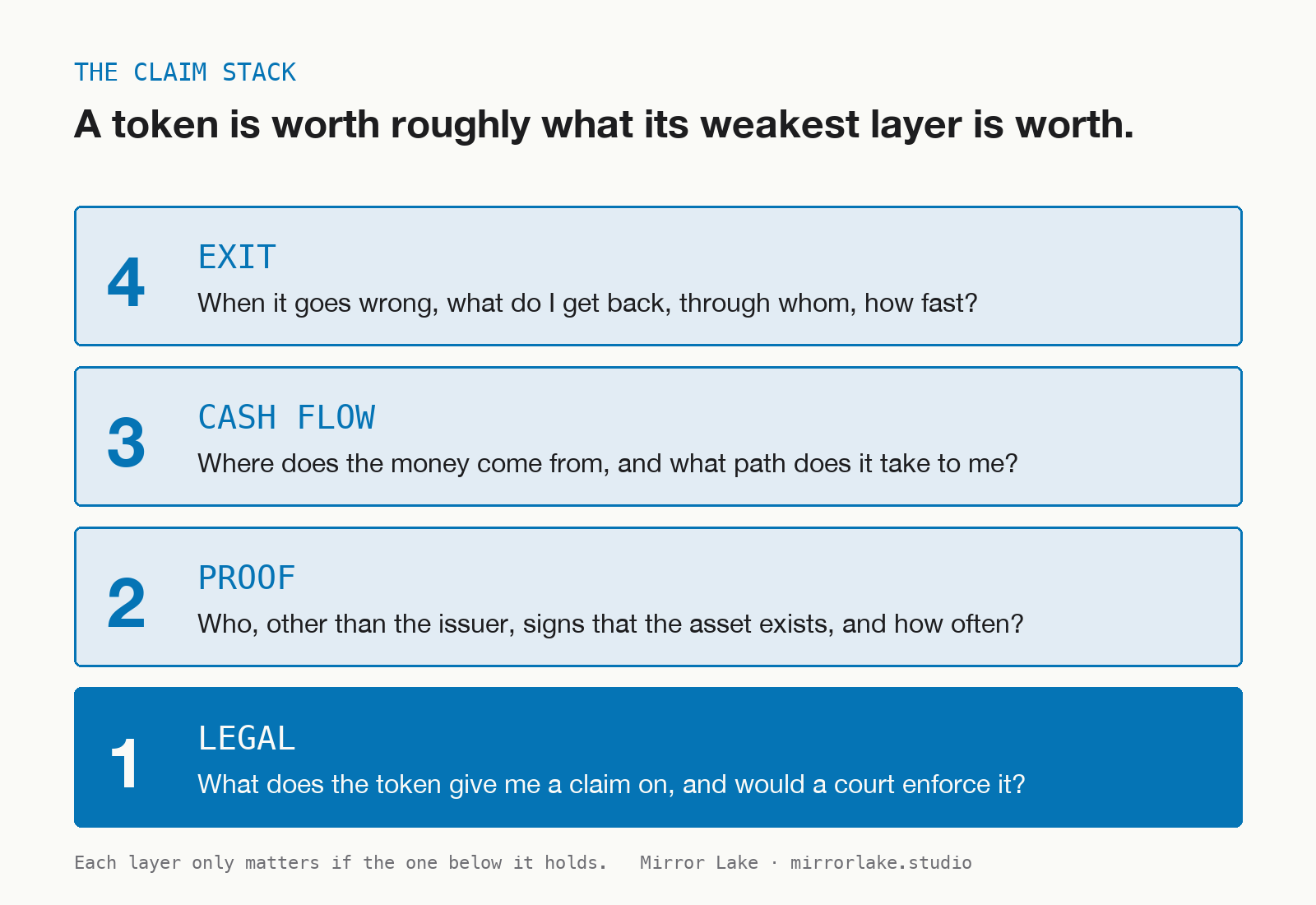
We use a simple model when we look at any real-world asset token. We call it the Claim Stack.我们看任何一个现实资产代币时,都用一个简单的模型,叫"权利四层栈"(The Claim Stack)。
Layer 1: Legal. What does the token give you a claim on, and would a court enforce it?第一层:法律。 代币让你对什么有权利?法院认不认?
Layer 2: Proof. How do you know the asset exists, is where they say, and is not promised to someone else?第二层:证明。 你怎么知道资产真的存在、在他们说的地方、没有同时许给别人?
Layer 3: Cash flow. Where does the money come from, and what path does it take to reach you?第三层:现金流。 钱从哪来,走什么路径到你手上?
Layer 4: Exit. When something goes wrong, what can you get back, through whom, and how fast?第四层:退出。 出事的时候,你能拿回什么、通过谁、要多久?
The layers stack. Each one only matters if the one below it holds. A brilliant cash-flow design on top of a claim no court will enforce is a brilliant design for someone else's money. Perfect proof of an asset you have no right to is a very well-documented gift.这四层是叠起来的,上面一层只有在下面一层站得住时才有意义。一个法院不认的权利上面,设计得再漂亮的现金流,也是在替别人的钱做设计。一份你根本无权主张的资产,证明做得再完美,也只是一份记录详尽的礼物。
A token is worth roughly what its weakest layer is worth.一个代币大致只值它最弱那一层的价值。
Let's go through them.下面一层一层讲。
Layer 1, legal: if a court cannot see it, it does not exist第一层,法律:法院看不见的,就不存在
A token is a line in a database. On its own it gives you nothing. Its value comes entirely from a legal document that says what the holder of that line is entitled to.代币只是数据库里的一行。它本身什么也不给你。它的价值,完全来自一份法律文件,写明持有这一行的人有权得到什么。
So the first question is not "what is the asset?" It is "what is my claim, and against whom?"所以第一个问题不是"资产是什么",而是"我的权利是什么,向谁主张"。
There are only a few honest answers:诚实的答案只有几种:
- You own a share of a fund that holds the asset. Your rights are in the fund documents.你持有一只基金的份额,基金持有资产。你的权利写在基金文件里。
- You own a share of a company that holds the asset, usually a special-purpose vehicle set up just for it. Your rights are in the company's constitution and shareholder agreements.你持有一家公司的股份,公司持有资产,通常是专门为这项资产设立的项目公司。你的权利写在公司章程和股东协议里。
- You are owed money by that company, as a lender. Your rights are in a loan or note agreement, and ideally in a security package that lets a trustee or security agent seize the asset if you are not paid.那家公司欠你钱,你是出借人。你的权利写在借款或票据协议里;最好还有一套担保安排,让受托人或担保代理人在你收不到钱时,有权处置资产。
- You own a direct interest in a specific physical asset, like an allocated bar in a vault. Your rights are in the custody agreement.你直接拥有某件实物资产的一份权益,比如金库里分配到你名下的一根金条。你的权利写在托管协议里。
Notice what is missing from that list: "you own the asset because the token says so." In almost every jurisdiction, that sentence means nothing.注意这份清单里少了什么:"因为代币上这么写,所以资产归你。"几乎在所有法域,这句话都没有意义。
Three things to look for:要看三件事:
Isolation. Is the asset held in a structure that is separate from the issuer's own business, so that if the issuer goes bankrupt, its creditors cannot take your asset? This is what a well-built special-purpose vehicle is for.隔离。 资产是否放在一个和发行方自身业务分开的结构里,这样发行方破产时,它的债权人拿不走你的资产?设计得好的项目公司,作用就在这里。
Security. If you are a lender, is there a registered security interest over the asset or the shares of the entity holding it, and is there a named party with the power to enforce it on your behalf? A loan with no security is a hope.担保。 如果你是出借人,资产或持有资产的公司股份上,有没有登记过的担保权益?有没有一个明确的主体,有权代表你去执行?没有担保的借款,只是一个希望。
Consistency. Do the legal documents and the smart contract say the same thing? If the contract lets an admin freeze or reissue tokens, but the documents never mention it, you have two different products and you only read one of them.一致。 法律文件和智能合约说的是不是同一件事?如果合约允许管理员冻结或重发代币,法律文件却只字未提,你买的就是两个不同的产品,而你只读了其中一个。
The best projects publish a plain-language summary of the legal claim on their own site. The worst ones send you to a whitepaper that uses the word "backed" forty times and never names the entity you have a claim against.最好的项目,会在官网上用大白话写清楚持有人的法律权利。最差的,会把你引到一份白皮书,里面写了四十遍"有资产背书",却从来没说出你到底向哪个主体主张权利。
Layer 2, proof: someone has to sign, and it cannot be the issuer第二层,证明:必须有人签字,而且不能是发行方
In crypto, proof of reserves is easy because the reserves are on chain. A wallet balance is public. Anyone can check it.在加密行业,储量证明很容易,因为储备就在链上,钱包余额公开,谁都能查。
Real-world assets do not live on chain. So "proof" means documents, and documents mean signatures. The only questions that matter are who signs, how often, and whether they are independent of the issuer.现实资产不在链上。所以"证明"意味着文件,文件意味着签字。真正要问的只有三件事:谁签、多久签一次、签字的人是否独立于发行方。
Proof looks completely different depending on the asset:不同资产,证明方式完全不同:
- Gold in a vault is proven by a bar list (serial numbers, refiner, weight, fineness) held by a custodian that is not the issuer, and by physical counts from an independent auditor.金库里的黄金:由发行方以外的托管方保管的金条清单(编号、精炼厂、重量、成色),加上独立审计师的实地盘点。
- A deposit in the ground is proven by a technical report signed by a qualified person under a recognised code. An estimate of what might be there is not the same as a reserve that can be mined at a profit, and an inferred resource cannot be counted as a reserve at all.地下的矿:由有资质的专家按公认标准签字的技术报告。"可能有多少"的估算,不等于"能盈利开采"的储量;推断级资源量根本不能算作储量。
- Receivables are proven by the debtor confirming the invoice is real and unpaid. The classic fraud is not a fake invoice. It is the same invoice financed twice.应收账款:由债务人确认发票真实且尚未付款。经典的欺诈不是假发票,而是同一张发票融资两次。
- Fund shares and treasuries are proven by custodian statements and the fund administrator's records.基金份额和国债:托管行对账单和基金管理人的记录。
- Property is proven by the land registry, a search for existing mortgages and charges, and an independent valuation.房产:土地登记、对现有抵押和押记的查询,以及独立估值。
Then ask about the type of proof. An audit, an attestation, a registry record and a technical report are not interchangeable. An attestation, for example, confirms what management said on one date. It is useful. It is not an audit.然后要问证明的类型。审计、鉴证、登记记录、技术报告,不能互相替代。比如"鉴证"只确认管理层在某一天的说法,有用,但不是审计。
What can the blockchain add here? Three useful things. It can timestamp each document and record its fingerprint, so a report edited later no longer matches. It can publish a custodian's data on a schedule, so anyone notices when the feed stops. And it can refuse to mint new tokens beyond what the latest proof supports.区块链在这里能加什么?三件有用的事:给每份文件打时间戳、记下它的"指纹",事后被改过的报告就对不上了;按时公布托管方的数据,数据一断谁都能发现;以及拒绝增发超过最新证明所支持数量的代币。
What it cannot do is make a document true. A fingerprint of a false report is a permanent record of a false report.它做不到的,是让一份文件变成真的。一份假报告的指纹,就是一份假报告的永久记录。
"Trust, but verify." — Russian proverb, made famous by Ronald Reagan"信任,但要核实。"——俄罗斯谚语,因里根而广为人知
In RWA, verify means one thing: find the signature, then find out who it belongs to.在 RWA 里,"核实"只有一个意思:找到签字,再查清楚是谁签的。
Layer 3, cash flow: follow the money backwards第三层,现金流:倒着追钱
A token that pays you is only as good as the path the money travels to reach you. So trace it backwards, from your wallet to the real world.一个会给你分钱的代币,好坏取决于钱流到你手上的那条路。所以要倒着追:从你的钱包追回到现实世界。
Where does each payment come from? Interest on bills. Rent from tenants. Repayments from borrowers. Revenue from selling a commodity. Each source has a name, a contract and a schedule. If you cannot name the source, you cannot judge the payment.每一笔钱从哪来?国债利息、租户的租金、借款人的还款、卖大宗商品的收入。每一个来源都有名字、有合同、有时间表。说不出来源,就无法判断这笔钱。
Who touches the money on the way? Usually a bank account in the real world, a company that collects it, a conversion step into a stablecoin, and a contract that distributes it. Every hop is a place it can be delayed, diverted or reduced by fees.路上经过谁的手?通常是:现实世界的一个银行账户、一家负责收款的公司、换成稳定币的一步、一个负责分配的合约。每多一站,就多一个可能被延误、挪用、或被手续费吃掉的地方。
In what order do people get paid? This is the waterfall. Operating costs, taxes, senior lenders, fees, and then you, or some other order. The waterfall is where most of the value of a deal is decided, and it is often missing from the marketing entirely.按什么顺序分钱?这就是"分配瀑布":运营成本、税、优先级出借人、各种费用,然后才轮到你,或者是别的顺序。一笔交易的大部分价值,就是在这个顺序里决定的,而宣传材料里往往完全不提。
And the question that matters most: is the yield coming from the asset, or from new buyers? A product that pays early holders with money from later holders is not a real-world asset product. It is the oldest scheme in finance with a smart contract attached.最重要的一个问题:收益是来自资产,还是来自新买家?用后来者的钱给早期持有人分红的产品,不是现实资产产品,而是金融史上最古老的骗局,外面套了一个智能合约。
A healthy structure is boring to describe. Money comes in from a named source under a signed contract, goes through a bank account you can identify, follows a written waterfall, and arrives on a schedule. When the description is exciting, look harder.健康的结构,说起来很无聊:钱来自一个有名有姓的来源、有签好的合同,经过一个你能查到的银行账户,按写好的顺序分配,按时到账。描述得越激动人心,越要多看两眼。
Layer 4, exit: the only test that matters happens on a bad day第四层,退出:唯一重要的考验,发生在糟糕的那一天
Everything works on a good day. Tokens trade, redemptions clear, the dashboard is green.一切顺利的时候,什么都没问题:代币能交易,赎回能到账,仪表盘一片绿。
The exit layer asks what happens on a bad day. The asset loses value. The issuer is in trouble. Everyone wants out at once.退出这一层问的是:糟糕的那一天会怎样。资产贬值了,发行方出事了,所有人同时想走。
Four questions:四个问题:
Can you redeem, or can you only sell? A redemption right lets you go back to the issuer or fund and get the underlying value. Without one, your only exit is finding another buyer, and on a bad day there may not be one.你能赎回,还是只能卖? 有赎回权,你可以回到发行方或基金那里,拿回底层价值。没有赎回权,你唯一的出路就是找到下一个买家,而在糟糕的那天,可能根本没有买家。
How long does redemption take, and can it be stopped? Many products allow redemption only on certain dates, with notice periods, and with the right to suspend or "gate" redemptions under stress. That can be perfectly reasonable. It just needs to be written down before you buy.赎回要多久,能不能被叫停? 很多产品只在特定日期允许赎回,要提前通知,在压力时期还有权暂停赎回,也就是"设闸"。这完全可以是合理的,只是必须在你买之前就写清楚。
Who can actually hold the token? Most serious RWA tokens can only be transferred to verified, eligible wallets. That protects the issuer legally, but it also shrinks the pool of buyers you can sell to.谁有资格持有这个代币? 大多数正规的 RWA 代币,只能转给经过审核、符合资格的钱包。这在法律上保护了发行方,但也缩小了你能卖给的买家范围。
If the issuer fails, who acts for you? In a well-built structure there is a trustee or security agent with the duty and the power to enforce the claim and distribute what is recovered. In a weak one, holders are left to organise themselves after the fact.发行方倒了,谁替你出面? 结构做得好的,会有一个受托人或担保代理人,有责任、也有权力去执行权利,并分配追回来的钱。结构做得差的,持有人只能事后自己组织起来。
If you only have time to check one layer, check this one. It is where the gap between marketing and reality is widest.如果你只有时间检查一层,就查这一层。宣传和现实之间的差距,在这里最大。
Two gold tokens, one stack两个黄金代币,同一套检查
To make this concrete, imagine two tokens. Both are called "tokenized gold". Both trade at roughly the price of an ounce. Both have a dashboard. They are made up, but every feature below exists in real products.说具体一点,设想有两个代币,都叫"代币化黄金",价格都差不多是一盎司金价,都有仪表盘。它们是虚构的,但下面每一个特征,在真实产品里都存在。
Token A. The website says each token is "backed by one ounce of gold held in a secure vault." The vault is not named. The token is issued by a company in one country; the gold, if it exists, is held by another. There is a monthly PDF called a "reserve report", signed by the issuer's own finance team. There is no redemption; you exit by selling on an exchange. The terms of service allow the issuer to "pause or migrate the contract at its discretion."代币 A。 官网说每个代币"由存放在安全金库中的一盎司黄金背书"。金库没写名字。代币由一个国家的公司发行,黄金(如果真有的话)放在另一个国家。每月有一份叫"储备报告"的 PDF,由发行方自己的财务团队签字。不能赎回,想退出只能去交易所卖。服务条款允许发行方"自行决定暂停或迁移合约"。
Token B. Each token is a claim on one ounce of allocated gold held in a named vault by a named custodian, under a custody agreement that keeps the metal outside the issuer's balance sheet. The full bar list, with serial numbers, is published and updated whenever tokens are created or destroyed. An independent auditor counts the bars twice a year and the report is linked, dated and fingerprinted on chain. Eligible holders can redeem for metal above a minimum size or for cash, within a stated number of days, and the conditions under which redemption can be suspended are written in the terms.代币 B。 每个代币对应一盎司已分配的黄金,存放在写明名字的金库、由写明名字的托管方保管,托管协议让这些金属不在发行方的资产负债表上。完整的金条清单连同编号公开发布,每次代币增发或销毁都会更新。独立审计师每年盘点两次,报告附在网上,注明日期,并把指纹记录上链。符合资格的持有人,在达到最低数量后可以赎回实物黄金或现金,写明了多少天内完成,什么情况下可以暂停赎回也写在条款里。
Run them through the stack.用四层栈过一遍:
Legal: A gives you a sentence. B gives you a named claim, kept separate from the issuer.法律:A 给你一句话。B 给你一项写明了的、和发行方隔离开的权利。
Proof: A gives you the issuer vouching for itself. B gives you a bar list and an outside signature with a date.证明:A 是发行方自己给自己作证。B 有金条清单和一个带日期的外部签字。
Cash flow: neither pays income, because gold does not. That is fine. The question is whether the price you pay matches what you can claim, and only B lets you check.现金流:两者都不分红,因为黄金本身不产生收入,这没问题。问题在于你付的价格和你能主张的东西是否对得上,而只有 B 让你查得到。
Exit: A gives you an exchange order book. B gives you a written right to get the metal or the money back.退出:A 给你一个交易所的买卖盘。B 给你一项写明了的、拿回金属或拿回钱的权利。
On a good day, A and B trade at the same price. On a bad day, they are not the same asset. That difference is invisible on the dashboard and obvious in the stack.一切顺利的时候,A 和 B 价格一样。糟糕的那天,它们根本不是同一种资产。这个差别在仪表盘上看不见,在四层栈里一目了然。
Most projects build half of the first layer and a beautiful website大多数项目只做了第一层的一半,外加一个漂亮的网站
Put the four layers side by side and a pattern appears.把四层并排放在一起,规律就出来了。
Many projects have a token, a smart contract, a polished front end and a sentence that says "backed by". That is half of the legal layer and none of the others.很多项目有代币、有智能合约、有精致的前端,再加一句"有资产背书"。这只是法律层的一半,其他三层都没有。
Some have done the legal work properly but publish proof once at launch and never again. The second layer quietly decays.有些项目把法律工作做扎实了,却只在上线时公布一次证明,之后再也没有。第二层在悄悄失效。
Some have real assets and real proof but pay holders through an opaque chain of entities and accounts. The third layer is a black box.有些项目资产是真的、证明也是真的,却通过一串说不清的主体和账户给持有人付钱。第三层是个黑箱。
Very few have thought hard about the fourth layer at all, because no one asks about exits when prices are going up.几乎没有项目认真想过第四层,因为价格在涨的时候,没人问怎么退出。
None of this means tokenization is a bad idea. It is the opposite. Tokenization can make the boring parts of finance, the proof, the payments, the record of who owns what, more visible and more checkable than they have ever been. But only if the layers underneath are built. The chain makes a good structure transparent. It does nothing for a bad one.这一切都不是说代币化是个坏主意,恰恰相反。代币化能让金融里那些无聊的部分,证明、付款、谁拥有什么的记录,变得前所未有地透明、可核查。但前提是下面这几层真的搭起来了。区块链能让一个好结构变得透明,对一个坏结构却毫无帮助。
The winners in this market will not be the projects with the best launch. They will be the ones whose tokens still mean something in year three.这个市场里的赢家,不会是上线做得最好的项目,而是三年后代币依然有意义的那些。
Run the stack before you buy: 10 questions买之前,用四层栈查一遍:10 个问题
Use these on any real-world asset token, including ours.拿这些问题去问任何一个现实资产代币,包括我们自己的。
Legal法律
- What exactly does the token give me a claim on: the asset, a company or fund that holds it, or a loan to that company?这个代币到底让我对什么有权利:资产本身、持有资产的公司或基金,还是借给那家公司的一笔钱?
- Is the asset held separately from the issuer, so the issuer's creditors cannot reach it?资产是否和发行方隔离开,发行方的债权人拿不走?
- Do the legal documents and the smart contract say the same thing, including about freezing and reissuing tokens?法律文件和智能合约说的是不是同一件事,包括冻结和重发代币的权力?
Proof证明
- Who, other than the issuer, signs the proof that the asset exists, and how often?除了发行方,谁在"资产存在"的证明上签字,多久签一次?
- Is it an audit, an attestation, a registry record or a technical report, and what is its date?这份证明是审计、鉴证、登记记录还是技术报告,日期是哪天?
- How would I find out if the same asset were pledged or sold to someone else?如果同一份资产被抵押或卖给了别人,我怎么才能知道?
Cash flow现金流
- Where does each payment come from, under which contract, and through which accounts?每一笔钱从哪来、依据哪份合同、经过哪些账户?
- What is the payment order, and where do I sit in it?分钱的顺序是什么,我排在哪?
Exit退出
- Can I redeem, how long does it take, and under what conditions can redemption be suspended?我能不能赎回、要多久、什么情况下赎回可以被暂停?
- If the issuer fails, who has the duty and power to act for holders?发行方倒了,谁有责任、有权力替持有人出面?
An issuer that answers all ten plainly has usually built something real. One that answers with a link to a block explorer has usually not.能把十个问题都说清楚的发行方,通常是真的做了实事。拿一个区块链浏览器链接来回答的,通常没有。
Where this goes接下来
Real-world assets will keep moving on chain. The question is whether the tokens that represent them become trustworthy instruments or another wave of expensive lessons.现实资产会继续上链。问题在于,代表它们的代币,会变成值得信任的金融工具,还是又一轮昂贵的教训。
That depends less on new technology than on the unglamorous work in the four layers: legal structures that hold, proof that someone independent signs, cash that follows a written path, and an exit that works on a bad day.这更多取决于四层里那些不光鲜的工作,而不是新技术:站得住的法律结构、有独立方签字的证明、沿着写好的路径流动的钱,以及在糟糕的那天也能用的退出机制。
We are Mirror Lake, a studio in Singapore. We build the technology for the parts of tokenization that sit under the token: proof-of-reserve and disclosure portals, milestone-based escrow, and the contracts that tie a token to what it is supposed to represent. We will keep writing about how to build and judge each layer.我们是镜湖(Mirror Lake),一家新加坡的工作室。我们为代币化里"代币下面那几层"开发技术:储量证明与信息公示门户、按里程碑放款的托管机制,以及把代币和它应当代表的东西绑在一起的合约。我们会继续写每一层该怎么搭、怎么判断。
If this was useful, follow along. And if you have seen one of the four layers done exceptionally well, reply and tell us how.如果这篇对你有用,欢迎关注。如果你见过哪个项目把四层中的某一层做得特别好,欢迎回复告诉我们是怎么做的。
More: mirrorlake.studio/rwa.html更多:mirrorlake.studio/rwa.html
FAQ常见问题
Short answers简短回答
What is the Claim Stack?
A four-layer model for judging a real-world asset token: legal (what the token gives a claim on and whether a court would enforce it), proof (who independent of the issuer signs that the asset exists), cash flow (where payments come from and how they reach holders) and exit (what holders get back, through whom and how fast when things go wrong). A token is worth roughly what its weakest layer is worth.
Why will most RWA tokens be worth little?
Not because the assets are fake, but because many tokens never give holders an enforceable, provable, payable and exitable right to the asset. Many projects build a token and a website but leave the legal structure, independent proof, cash-flow path and exit rights incomplete.
What should I check before buying a real-world asset token?
What the token is a claim on and against whom; whether the asset is isolated from the issuer; who independent signs the proof and how often; where payments come from and the payment order; whether you can redeem and under what conditions redemption can be suspended; and who acts for holders if the issuer fails.
Contact联系
Let’s talk. 欢迎联系。
Enterprise AI, SGfoto, or brand GEO. Book 30 minutes, write, or add us on WeChat. 企业 AI、SGfoto,或品牌 GEO——预约 30 分钟,或发邮件 / 加微信。
Google Calendar booking page.Google Calendar 预约页。
Book 30 minutes预约 30 分钟For Corvus product questions: hi@corvusai.io.Corvus 产品问题也可写 hi@corvusai.io。
Write to us发邮件